/test-improve¶
File: skills/test-improve/SKILL.md
Role: orchestrator.
/test-improve is the consolidated analyze-then-improve orchestrator for
legacy or in-flight test suites. It is one of the plugin's two multi-phase
pipelines with inter-phase human gates (the other is /ship).
It defaults to lightweight ceremony. It prompts for heavier capabilities
(Gherkin extraction, mutation testing, refactor-for-testability) only on
demand. It always baselines coverage (and mutation, when enabled) before any
test change.
This page is the canonical phase reference. To see where /test-improve sits
among the plugin's other commands, read workflows.md. To see how it
fits the wider agent architecture, read
agent-architecture.md.
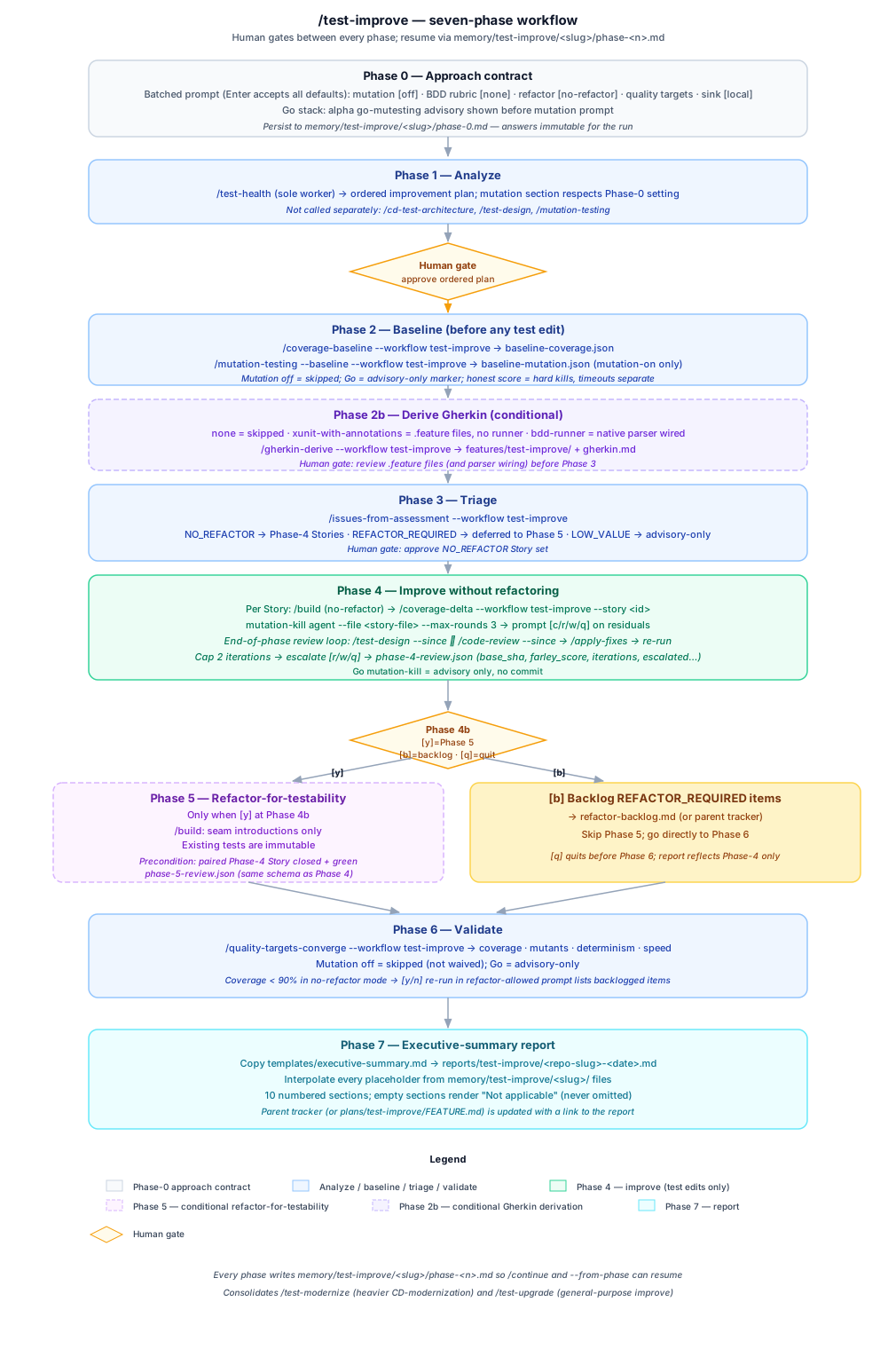
Phases¶
Each phase writes a progress file to
.claude/memory/test-improve/<slug>/phase-<n>.md so /continue (and --from-phase)
can resume.
Execution order. Phases keep their historical identity numbers (Phase 1
is always Analyze, Phase 2 is always Baseline, and so on). Baseline (Phase 2)
and Derive Gherkin (Phase 3) execute before Analyze (Phase 1), so
/test-health can use documented-but-untested Gherkin scenarios as a
coverage signal. The order is 0 → 2 → 3 → 1 → 4 → 5 → 6 → 7 → 8 → 9.
Phase 7 and Phase 8 are not alternatives. When Phase 6 returns [y], both
run in sequence. Otherwise, Phase 8 follows Phase 6 directly. When the BDD
binding mode is none, Phase 3 is skipped and the sequence becomes
0 → 2 → 1 → 4 → 5 → 6 → 7 → 8 → 9. The list below follows this execution
order, not numeric order. The phase-start banner prints a separate
Step <position>/<total> — Phase <N>: <name> counter. <position> is a
running count of phases printed so far this run (never a fixed per-identity
slot). <total> is computed per run (base 9, -1 when BDD binding mode
is none, +1 once Phase 6 enters Phase 7) rather than a hardcoded 9 or 10.
- Phase 0 — Approach contract. Batched prompt (Enter accepts all
defaults): mutation mode
[kill-loop](off/kill-loop/baseline+kill-loop), BDD rubric[none], refactor[no-refactor], quality targets, sink (--parent <url>vs local files), and the all-or-none code-lookup install (explicity/n, not part of Enter-accepts-all). An Enter-through run now performs the mutant-kill loop by default. Go stack shows the alpha go-mutesting advisory before the mutation prompt. Answers are immutable for the run. Phase 0 surfaces a stated coverage target that is structurally unreachable underno-refactoras[w] waive / [s] switch to refactor-allowed / [c] continue as-is, computed byscripts/coverage_gap_ranking.py. With no coverage report on disk yet, Phase 0 records the check asdeferredand re-runs it at Phase 2 (#1787). - Phase 2 — Baseline (before any test edit).
Run
/coverage-baseline --workflow test-improveunconditionally. Run/mutation-testing --baseline --workflow test-improveonly inbaseline+kill-loopmode (offandkill-looptake no baseline). Go is an advisory-only marker. The honest score counts hard kills and reports timeouts separately. Thenscripts/coverage_gap_ranking.pywritesdata/coverage-gap-ranking.json: per-module buckets ranked by uncovered lines descending, each markedseam: established|absent. Phases 1, 4, and 5 read this file as their targeting input instead of mutation survivors (#1786). A deferred Phase-0 conflict check also resolves here. - Phase 3 — Derive Gherkin (conditional).
noneskips entirely (Phase 1 follows Phase 2 directly in that case).xunit-with-annotationswrites.featurefiles without a runner.bdd-runnerwires the native parser. - Phase 1 — Analyze. Delegate to
/test-health(sole worker). Make no separate calls to/cd-test-architecture,/test-design, or/mutation-testing. Whenever a coverage percentage is a stated goal, order the improvement plan's coverage-driven items bycoverage-gap-ranking.jsonrank, never by mutation survivor count. Survivors order work only within aseam: establishedmodule (#1786). The mutation section respects the Phase-0 setting. A separate, direct classification pass persists a before-snapshot of test counts by MinimumCD type totest-counts-before.json.--analyze-onlyruns Phase 0 then this phase directly, bypasses the Baseline/Derive-Gherkin ordering above, and exits with no baseline captured. - Phase 4 — Plan fixes.
/issues-from-assessment --workflow test-improvepartitions findings intoNO_REFACTOR(Phase-5 Stories) /REFACTOR_REQUIRED(deferred to Phase 7) /LOW_VALUE(advisory-only). The command writes the NO_REFACTOR Story set incoverage-gap-ranking.jsonrank order when a coverage percentage is a stated goal (#1786). - Phase 5 — Improve without refactoring. Per Story, run these steps in order:
/build(no-refactor)./coverage-delta --workflow test-improve --story <id>.scripts/coverage_delta_steering.py. Three consecutive near-zero-delta Stories exit 3 and prompt[t] re-check Phase-1 targeting / [c] continuemid-phase (#1790).mutation-killagent, dispatched once per module batch (--file <every story file in the batch> --max-rounds 3 --target-honest-score <Phase-0 mutation target>, #2030). Residuals prompt[c/r/w/q].scripts/mutation_yield_steering.pyat the batch boundary. Two consecutive batches that kill fewer than the minimum net survivors exit 3 and prompt the same[t] re-check Phase-1 targeting / [c] continue(#2033). This ports the #1790 mechanism to the more expensive lane, sharing its status vocabulary and exit-code contract.
The end-of-phase review loop dispatches /code-review --since <base-sha> --internal
once. It does not dispatch /test-design in parallel. test-review and
test-smell-review (the two agents /test-design used to add) are
already in /code-review's own roster for a test/seam-scoped diff. That dual
dispatch was a duplicate, so #1966/#1987 removed it. The loop confirms the
change-size gate did not drop those two test lenses. It scores
Farley on the in-scope test files, runs /apply-fixes, then runs a narrowed
re-confirmation (not a full re-dispatch). The cap is 2 iterations, with [r/w/q]
escalation. See references/review-loop.md steps 1-5. Evidence is in
phase-5-review.json.
- Phase 6 — Refactor decision prompt. [y] enter Phase 7 / [b] backlog
and skip to Phase 8 / [q] quit. The letter y is deliberately chosen over
r, which is already claimed by mutation-kill's [c/r/w/q] (retry) and the
review loop's [r/w/q] (revise).
- Phase 7 — Refactor-for-testability (conditional). Runs only when [y].
Changes are seam-only production-code changes, and existing tests are immutable.
Each Story precondition-checks that the paired Phase-5 baseline is closed and
green. The phase uses the same end-of-phase review loop. Evidence is in
phase-7-review.json.
- Phase 8 — Validate. Run /quality-targets-converge --workflow test-improve
--refactor-mode <value>. Threading Phase 0's no-refactor/
refactor-allowed value keeps the coverage-gap dispatch table from
proposing a [Refactor-for-testability] Story once Phase 6 chose no-refactor.
The command writes a refactor-backlog.md entry
instead. Mutation off means skipped (not waived). Go is advisory-only.
When coverage is below 90% in no-refactor mode, a [y/n] re-run-in-refactor-allowed
prompt lists backlogged items and records coverage_reprompt_fired: true
in phase-8.md, so Phase 9's close-out prompt below does not re-ask. The
identical classification pass from Phase 1 recounts test-by-type into
test-counts-after.json. The workflow suggests /handoff here, and after Phase 1
and the Phase 5/7 review loops, the context-heaviest boundaries.
- Phase 9 — Executive-summary report. Interpolates the shipped
templates/executive-summary.md
from the git-tracked .dev-team-reports/test-improve/<slug>/data/
directory plus .claude/memory/test-improve/<slug>/ process/audit state to
.dev-team-reports/test-improve/<slug>/report-<date>.md. The report has 10
numbered sections. Empty sections render "Not applicable" (never omitted). § 1
includes a "Tests by type" table (Baseline/Achieved/Δ per MinimumCD type). § 7
foregrounds a seam-needed/behavior-gained/estimated-risk table sourced
from refactor-backlog.md. Phase 9 updates the parent tracker (or
.claude/plans/test-improve/FEATURE.md) with a link to the report.
The report is regeneratable from memory. After Phase 9, if
refactor-backlog.md has entries and Phase 8's re-run prompt never fired
this run, a close-out [y/n] prompt asks whether to re-run with
refactor-allowed mode.
Arguments¶
/test-improve <repo-path> [--parent <url>] [--analyze-only] [--from-phase <n>] [--stack <id>]
| Flag | Behavior |
|---|---|
<repo-path> |
Positional. Path to the repository to improve (required). |
--parent <url> |
Post progress and Stories to this tracker issue URL instead of local plan files. |
--analyze-only |
Run Phase 0–1 only; skip improvement phases. |
--from-phase <n> |
Resume from phase n (requires existing .claude/memory/test-improve/<slug>/ files). |
--stack <id> |
Override auto-detected stack identifier (for example go, python, java). |
/continue resumes any phase from .claude/memory/test-improve/<slug>/phase-<n>.md.
--from-phase <n> does the same explicitly and never re-prompts Phase 0.
--analyze-only runs Phase 0 + Phase 1 and exits before baseline capture.